Step by-Step Response Protocol
- Close the main water shutoff valve (0 to 3 minutes). Locate the main valve, typically on the interior wall facing the street, in a basement utility area, or inside a garage. Turn the gate valve clockwise until fully closed, or rotate a ball valve handle 90 degrees perpendicular to the pipe. If the valve is seized, shut the water off at the curb stop using a curb key. Verify shutoff by opening the lowest faucet in the home until flow stops.
- De energize affected circuits (3 to 6 minutes). At the main panel, switch off breakers feeding any room with standing water or wet ceilings. Do not enter standing water deeper than 1 inch with power still active. If the panel itself is wet or compromised, contact your utility before re entering.
- Drain residual line pressure (6 to 10 minutes). Open the highest hot and cold faucets in the home, then open the lowest. This relieves trapped pressure in 60 to 90 seconds and reduces drip from the rupture point. Flush toilets once to empty tank reservoirs. If your water heater is downstream of the rupture, close its cold inlet valve and turn the unit to pilot or off to prevent dry fire damage to the heating element.
- Identify and isolate the rupture (10 to 20 minutes). Trace water staining or audible drip to the failure point. Common locations include copper pinhole failures at fittings, PEX clamp slippage, frozen sections behind exterior walls, and corroded galvanized nipples at water heaters. Inspect washing machine supply hoses, ice maker lines, and angle stops under sinks. Rubber supply hoses older than 5 years have a 30 to 40 percent higher failure rate than braided stainless. For frozen pipe failures, review our notes on frozen pipe burst repair before applying any heat.
- Document the loss for insurance (parallel task). Capture 20 to 40 photographs including wide shots of each affected room, close ups of the rupture, water lines on walls, and serial numbers of damaged appliances. Record a slow 360-degree video of each space. Save the timestamp. Keep the failed pipe section, fitting, or hose in a sealed bag for the adjuster. Write a short timeline noting when the leak was discovered, when shutoff occurred, and when Albany Water Restoration was contacted in Albany.
- Remove standing water (20 to 90 minutes). Use a wet/dry vacuum rated for at least 6 gallons. Extract from the lowest points first. A typical homeowner unit removes 1 to 3 gallons per minute. For volumes above 50 gallons or any water deeper than 2 inches across more than one room, professional truck mounted extraction at 100 to 200 gallons per minute is faster and more thorough.
- Lift wet contents off the floor (within 2 hours). Elevate furniture legs on 2-inch foam blocks or aluminum foil squares to prevent stain transfer and wicking. Remove area rugs, books, electronics, and cardboard storage. Wet cardboard wicks moisture into adjacent drywall at 0.5 inches per hour.
- Assess water category per IICRC S500. Category 1 is clean supply line water. Category 2 (grey water) includes dishwasher discharge or aquarium water. Category 3 (black water) includes sewage or floodwater. A clean supply rupture starts as Category 1 but degrades to Category 2 after 48 hours and Category 3 after 72 to 96 hours of contact with building materials. The water damage category breakdown details exact thresholds.
- Measure moisture content. Use a pin type meter on wood (dry standard 12 to 15 percent), a non invasive meter on drywall (dry standard under 1 percent moisture content), and a thermo hygrometer to log relative humidity. Target indoor RH is 30 to 50 percent during drying. Take baseline readings in an unaffected room of the same construction to establish your reference dry value.
- Make controlled cuts only when necessary. If drywall shows moisture above 1 percent at 12 inches off the floor, perform a 4-inch flood cut or full removal based on saturation height. Insulation behind wet drywall must be removed if compressed or wet. Refer to drywall removal guidelines for cut height decisions.
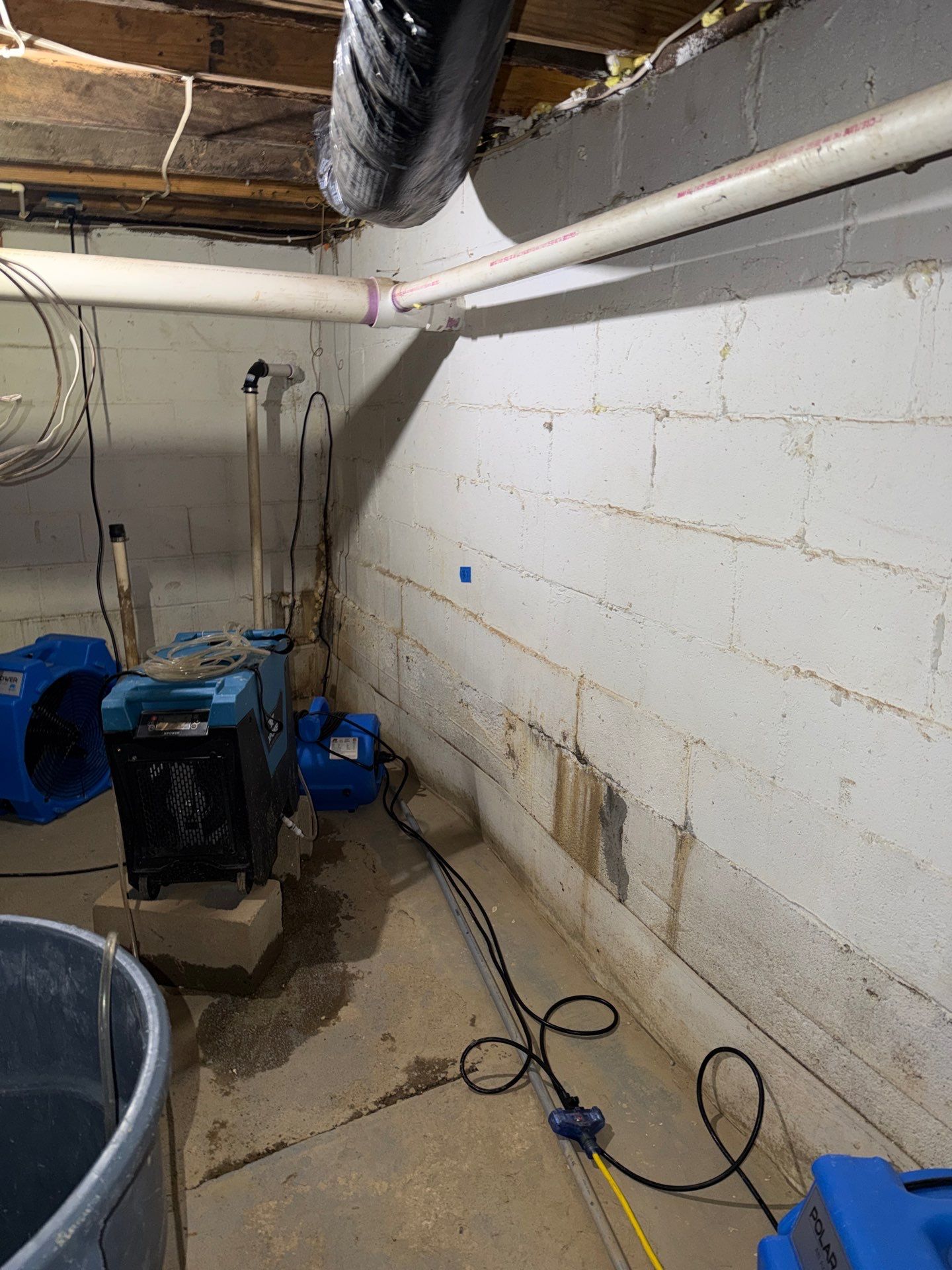
- Deploy drying equipment (within 2 hours of extraction). Standard residential drying uses 1 air mover per 50 to 60 square feet of wet surface and 1 LGR dehumidifier per 1,000 to 1,500 square feet of affected space. Air movers should be angled at 15 to 45 degrees against wet walls. Dehumidifiers should sit centrally and drain continuously.
- Monitor daily. Record moisture readings at the same locations every 24 hours. Expect drywall to dry in 3 to 5 days, subfloor in 4 to 7 days, and dense framing in 5 to 10 days. Adjust equipment placement if readings stall for 48 hours.
- Confirm dry standard before reconstruction. All materials must reach equilibrium with unaffected reference areas in the home. Document final readings, equipment run hours, and photographs of dry conditions before any drywall, flooring, or paint work begins.
Common Failure Points by Pipe Material
- Copper (Type M and L). Pinhole leaks at sweated joints, often after 15 to 25 years. Failures concentrate at horizontal runs with high water velocity above 5 feet per second.
- PEX-A and PEX-B. Crimp ring slippage at fittings, UV degradation if exposed to sunlight, and rodent damage in attics or crawlspaces.
- CPVC. Brittle fractures after 20 to 25 years, especially at threaded transitions to metal fittings.
- Galvanized steel. Internal corrosion narrows the bore and weakens nipples at water heaters, hose bibs, and meter connections. Common failure age is 40 to 60 years.
- Polybutylene. Known to fail at acetal fittings. If your home was built between 1978 and 1995, inspect for grey or blue piping and plan a replumb.
Specifications to Hand Your Contractor
- Time water ran before shutoff (minutes)
- Estimated gallons released
- Affected square footage per room
- Material types (drywall, plaster, hardwood, LVP, carpet, tile)
- Category assessment (1, 2, or 3)
- Initial moisture readings if available
- Pipe material and failure location
- Photographs and timestamped video files
This data set, paired with your insurer's claim number, lets a restoration crew arrive prepped with the correct equipment load on the first truck.
When to Call Albany Water Restoration
Call Albany Water Restoration immediately if any of these conditions apply in Albany: standing water across more than one room, water from an upper floor through ceilings, sewage backflow, water contact with electrical panels or HVAC equipment, or any rupture that ran undetected for more than 4 hours. Crews dispatch in most cases within 2 hours with truck mounted extraction, LGR dehumidifiers, antimicrobial agents for Category 2 and 3 losses, and moisture mapping equipment. Same day documentation is provided to your insurer.